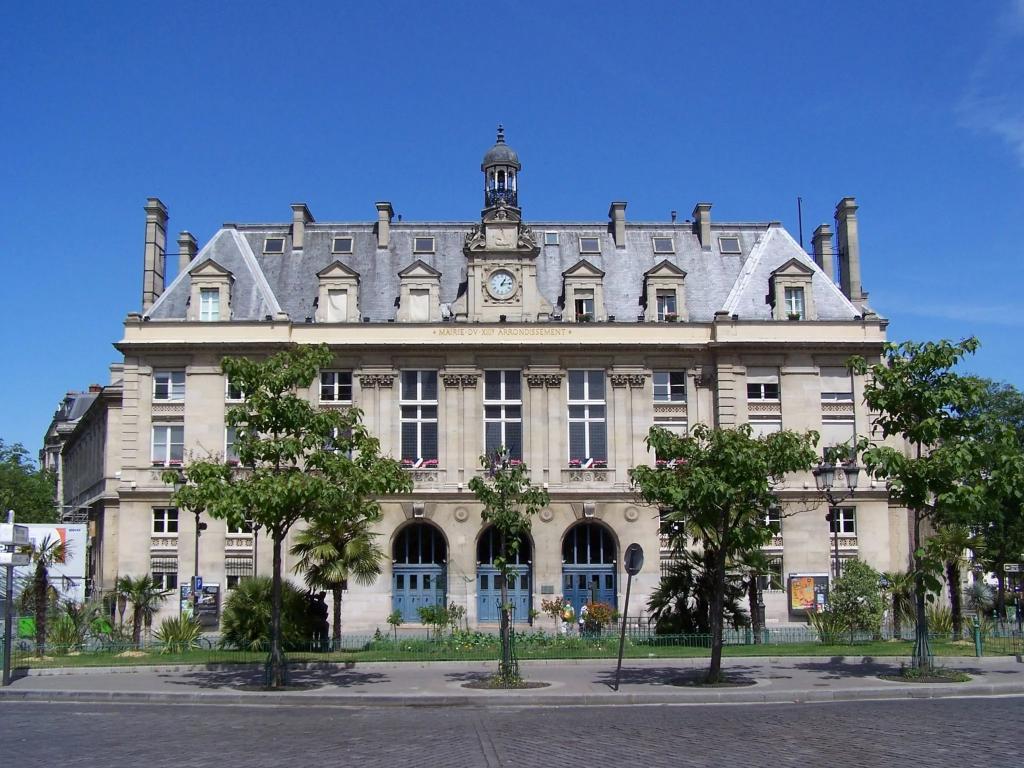
Discover the 13th Arrondissement of Paris
Published on : 2/13/25
Located at the foot of Olympiades metro station (Line 14), just a few minutes’ walk from Nationale (Line 6) and Tolbiac (Line 7), and with easy access to buses, bicycles and scooters, our neighbourhood is particularly well connected. From here, you can quickly reach all of Paris’s major landmarks. Whether you want to explore the historic centre, enjoy a drink in the Latin Quarter or Les Halles, or get to one of the city’s train stations or airports, all of Paris is within easy reach from the Tolbiac district where we are located. But during your visit to the capital, you may not even need to leave the 13th arrondissement. Although it is certainly not Paris’s most touristy district, it is in many ways a lively neighbourhood with plenty to discover.
Discovering the 13th arrondissement
Most visitors to the City of Light are familiar with its major landmarks, mainly located in the city centre. However, tourists often tend to overlook Paris’s residential and business districts on the outskirts. The 13th arrondissement, in the southern part of the city and not far from the famous Latin Quarter, Rue Monge and Rue Mouffetard, is nevertheless well worth a visit. Below, we introduce a few places and activities that you can easily enjoy on foot from the Urban Bivouac hotel.
The 13th arrondissement, Paris’s street art hotspot
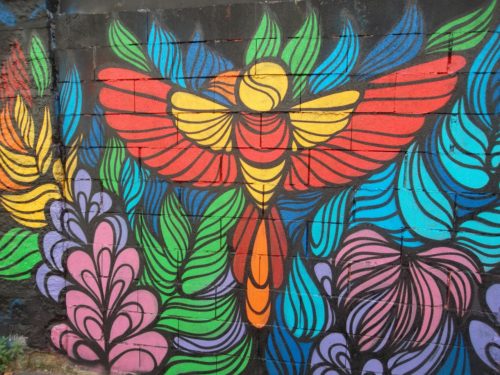
In recent years, Paris’s 13th arrondissement has become a favourite playground for street artists, turning into a true open-air museum. Near Nationale metro station, along Rue Jeanne d’Arc and Boulevard Vincent Auriol, you can admire more than a dozen murals. American artist Shepard Fairey has created several works here, including a particularly well-known mural featuring the French motto: ‘Liberty, Equality, Fraternity’.
Right nearby, you will also find a several-metre-high mosaic by French artist Invader, depicting the television series House.
Simply wander through the neighbourhood and you may suddenly find yourself face to face with a masterpiece such as the monumental mural Embrace and Fight, created by Irish artist Conor Harrington in April 2017, showing two men dressed in 18th-century clothing.
A village-like neighbourhood, Butte-aux-Cailles is a cobbled area of the 13th arrondissement, home to artists’ studios, galleries, picturesque houses, Art Deco architecture standing alongside modern high-rises, and lively café terraces — not to mention street art, which has also been part of the area for many years.
Butte-aux-Cailles is a popular, family-friendly neighbourhood in Paris. It offers many local shops and services and has a lively, welcoming atmosphere. This former village was incorporated into the capital in the 19th century but has preserved its authentic, working-class character. Local residents are attached to their neighbourhood and way of life. They are welcoming and warm. It is a neighbourhood where life feels good.
The area was listed as a historic monument in 1990. It features a 1920s swimming pool complex open to the public, with both an indoor pool and a unique year-round outdoor “Nordic” pool, whose water is heated using recovered heat from nearby technology data centres.
If you are looking for an authentic and popular Parisian neighbourhood, Butte-aux-Cailles is the place for you.
Paris’s Chinatown
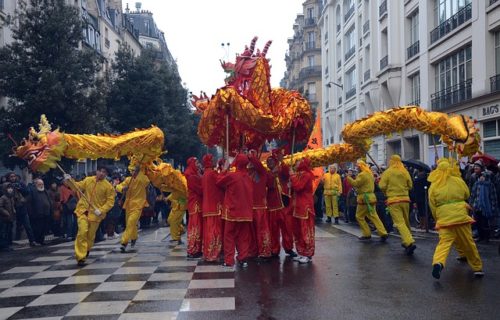 The 13th arrondissement is also home to the largest Asian community in France. Bringing together mainly Chinese, Cambodian and Vietnamese communities, the Parisian Chinatown can be found around the Olympiades area.
Located between Rue de Tolbiac and Avenue de Choisy, this neighbourhood is home to numerous Asian shops and restaurants. Paris’s Chinatown is a lively area where you can enjoy many typical dishes from Chinese cuisine.
It is considered by some to be the largest Chinatown in Europe and is the main site of Chinese New Year celebrations in Paris.
It is an ideal place to find a wide range of Asian shops and restaurants, especially Vietnamese pho houses. And you will have no trouble visiting it at any time, as the 3-star Urban Bivouac hotel is located just 50 metres from the Olympiades esplanade.
The National Library of France
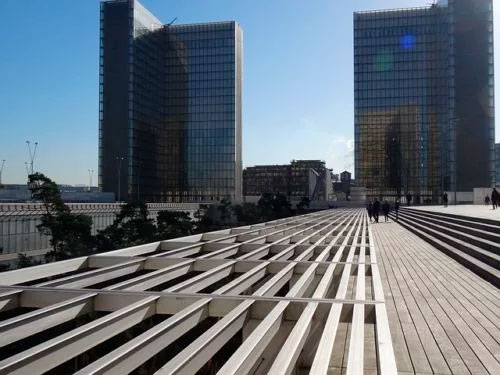
The National Library of France, also known as the François Mitterrand Library, is a modern glass building housing more than 15 million books and printed documents, manuscripts, engravings, photographs, maps, musical scores, coins, medals, sound recordings and much more, all preserving France’s national heritage.
Many cultural events, including special exhibitions, conferences, concerts and meetings, take place at the library throughout the year.
The National Library of France is open to the public Monday to Friday from 9 a.m. to 6 p.m. and Saturday from 9 a.m. to 5 p.m.
The National Library of France offers free services for all audiences, including document loans, access to online collections, workshops and conferences.
The Gobelins tapestry workshop
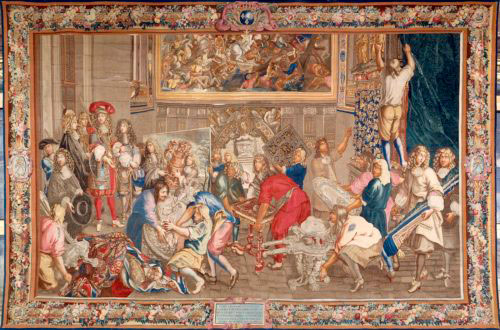
The Gobelins district is located in Paris’s 13th arrondissement. It is named after a former textile manufactory dating back to the Middle Ages. It is a popular neighbourhood that has retained its authentic character, with many local shops, cafés and restaurants.
This historic workshop complex dates back to the 15th and 16th centuries, when it was first used to create natural dyes for wool tapestries.
In the 17th century, hundreds of tapestries were produced here to furnish France’s royal residences. Today, the workshops of the Manufacture Nationale des Gobelins employ 30 people and operate 15 looms producing contemporary pieces.
The Gobelins district is also known as the birthplace of the famous painter Henri Matisse. The Rue du Docteur-Blanche, where Matisse grew up, was renamed in his honour. The Gobelins district is an authentic Parisian neighbourhood where life is pleasant. If you are looking for a quiet place full of charm, this area is well worth exploring. The complex is open to the public for special exhibitions and guided tours.
Austerlitz Station
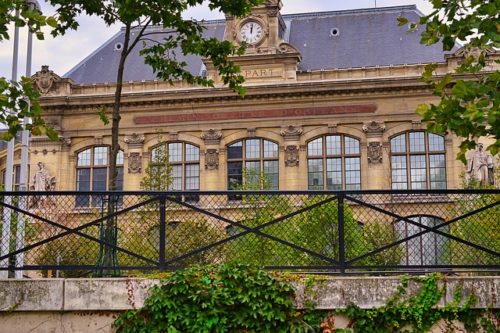
Built in 1840, Austerlitz Station is one of Paris’s main railway stations. Located on the banks of the Seine, the station takes its name from the famous Napoleonic battle.
Austerlitz Station has been renovated several times, notably in 2003. Today, it is considered one of the most modern and best-connected stations in Paris.
Today, trains carry passengers to cities in southern France, as well as to more distant destinations such as Barcelona and Madrid. It is located close to Gare de Lyon, Gare du Nord and Gare de l’Est.
While walking around Austerlitz Station, you can also explore the Seine riverbanks, which offer many attractions such as the Cité de la Mode et du Design.
Station F
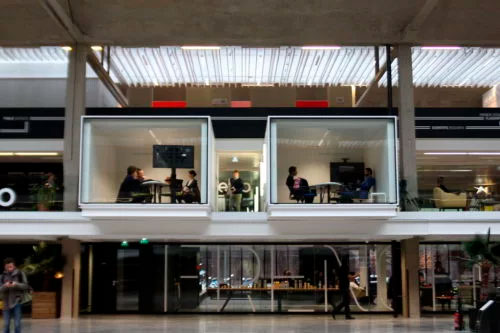
Considered the world’s largest start-up incubator campus, this ambitious complex opened in June 2017 in a huge former railway depot dating from the 1920s, now listed as a historic monument.
This vast facility was created to provide everything modern entrepreneurs need: offices, meeting rooms, event spaces, kitchens and even a restaurant.
Station F is accessible 24 hours a day, 7 days a week, and 600 residents are expected to be housed in 100 shared apartments.
You can reach all these places very easily from the 3-star Urban Bivouac hotel, where our reception staff will be happy to provide any information you may need. But do not think that the 13th arrondissement is limited to these few places and activities. During your walks, you will also have the opportunity to discover the Simone de Beauvoir footbridge on Quai François-Mauriac, the Pathé Foundation in Gobelins, the Austerlitz viaduct, Place d’Italie, Parc de Choisy, the Cité de la Mode et du Design, the educational farm at Parc Kellermann, Notre-Dame de la Gare Church, Sainte-Anne de la Butte-aux-Cailles Church, the Bièvre, the Cité Florale, the Jardin du Moulin-de-la-Pointe, the Buddhist temples of Olympiades, Square des Peupliers, the artesian well on Place Paul Verlaine, and many more places that we will try to cover in greater detail in future articles.


